Chapter 1: Base Version - Mastering Lowercase Letters (A-Z)
This chapter is the foundation of USTAAD Typing Academy's English typing course. It covers all 26 lowercase letters through eight carefully designed exercises. Each exercise focuses on four keys, with six progressive lessons that build muscle memory, home row technique, and typing confidence.
What You Will Learn in Chapter 1
- All lowercase letters A–Z using the QWERTY layout
- Proper home row finger placement
- Accurate key practice for each new letter group
- Word practice and sentence writing based on learned keys
- Paragraph writing and extended typing practice
- Game-based reinforcement with City Defender and Safe Drive
- Common beginner mistakes and how to avoid them
- Progress tracking and speed benchmarks for A-Z typing practice
Key Chapter 1 Benefits
- Lowercase typing fluency across the full alphabet
- Home row mastery with correct finger assignment
- Muscle memory development through repeated drills
- Context-based learning with words, sentences, and paragraphs
- Engaging practice via games that strengthen key recall
- Confidence building before moving to Shift Version
Chapter 1 Structure
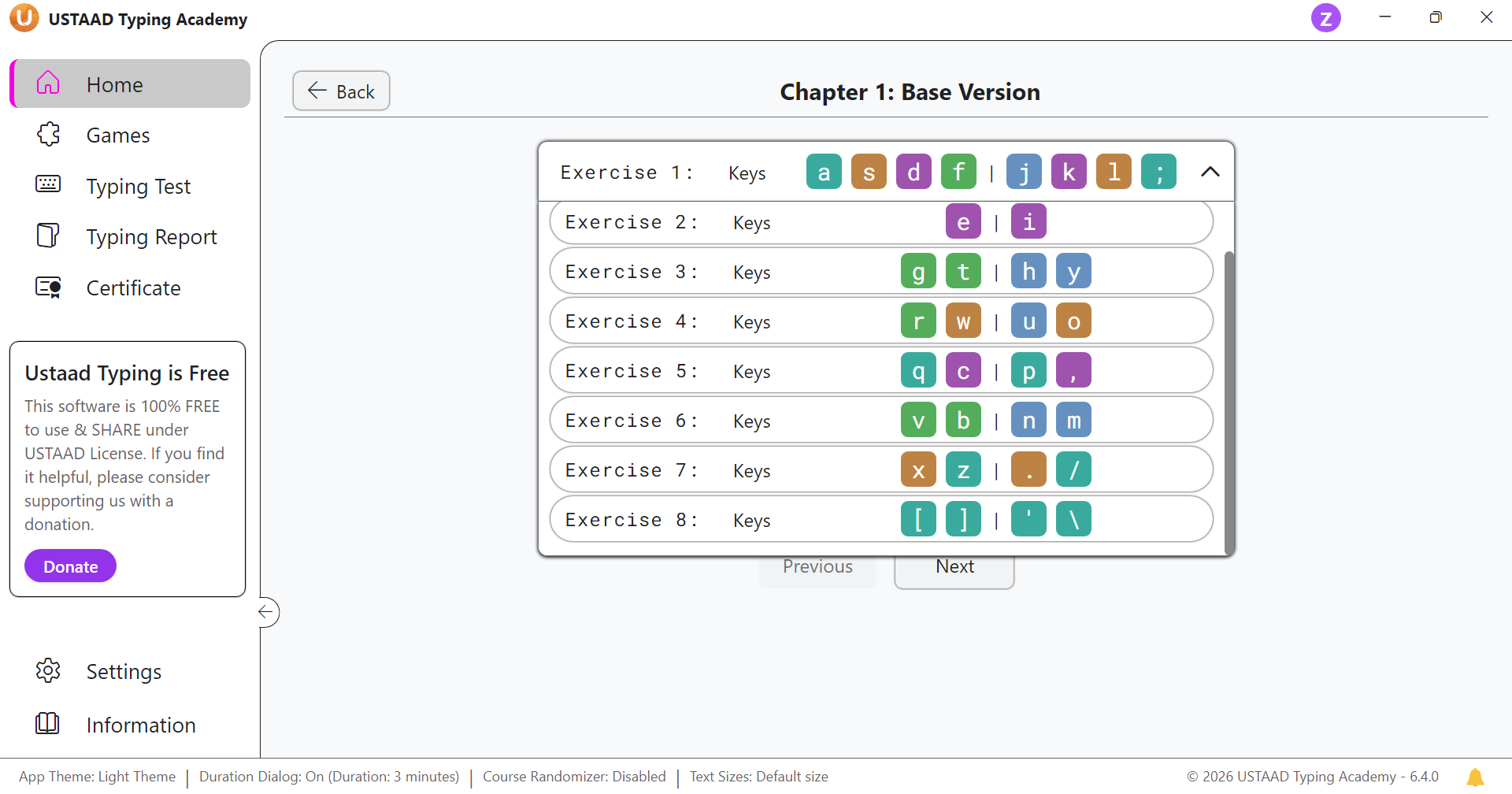
Chapter 1 is organized into eight exercises. Each exercise contains multiple lessons designed to reinforce the keys in different contexts.
Exercise 1: Home Row Keys [a, s, d, f] and [j, k, l, ;]
- 1.1-1 Keys Practice: Learn the home row letters using proper finger placement
- 1.1-2 Key Challenge: Play the City Defender game to strengthen home row accuracy
- 1.1-3 Word Practice: Practice selected words built from the learned keys
- 1.1-4 Play Game: Use City Defender again to reinforce the home row in a fun format
Exercise 2: Add [e, i]
- 2.1-1 Keys Practice: Add vowels e and i to the existing home row letters
- 2.1-2 Key Challenge: City Defender game with the expanded key set
- 2.1-3 Word Practice: Type practice words containing e and i
- 2.1-4 Play Game: City Defender word challenge for speed and precision
Exercise 3: Add [g, t] and [h, y]
- 3.1-1 Keys Practice: Learn the next letter group for middle-row typing
- 3.1-2 Key Challenge: City Defender with mixed keys to improve coordination
- 3.1-3 Word Practice: Practice more complex words using g, t, h, and y
- 3.1-4 Play Game: City Defender reinforcement for accuracy and rhythm
Exercise 4: Add [r, w] and [u, o]
- 4.1-1 Keys Practice: Add top-row letters for improved typing reach
- 4.1-2 Key Challenge: City Defender practice with the expanded alphabet set
- 4.1-3 Word Practice: Type words using the current key group
- 4.1-4 Sentence Writing: Write complete sentences using all learned keys so far
Exercise 5: Add [q, c], [p, comma]
- 5.1-1 Keys Practice: Introduce the non-standard keys q, c, p and the comma
- 5.1-2 Key Challenge: City Defender game with punctuation and letter keys
- 5.1-3 Word Practice: Type words that use q, c, p and comma patterns
- 5.1-4 Play Game: City Defender word challenge for fluency
- 5.1-5 Sentence Writing: Practice sentences using the new keys
- 5.1-6 Game Practice: Reinforce sentence-level spelling with City Defender
Exercise 6: Add [v, b, n, m]
- 6.1-1 Keys Practice: Learn the lower row letters v, b, n, and m
- 6.1-2 Key Challenge: City Defender game focused on lower-row coordination
- 6.1-3 Word Practice: Practice words containing v, b, n, and m
- 6.1-4 Play Game: City Defender word challenge for speed and precision
- 6.1-5 Sentence Writing: Build sentences with the expanded key set
- 6.1-6 Game Practice: Continue sentence-level reinforcement in City Defender
Exercise 7: Add [x, z], [., /]
- 7.1-1 Keys Practice: Add X, Z plus punctuation keys period and slash
- 7.1-2 Key Challenge: City Defender practice with punctuation and letters
- 7.1-3 Word Practice: Type words and short phrases with the new characters
- 7.1-4 Play Game: City Defender word challenge for punctuation skills
- 7.1-5 Sentence Writing: Practice sentences using punctuation and letters
- 7.1-6 Game Practice: Sentence game with City Defender for retention
Exercise 8: Add [[], ], ', ]
- 8.1-1 Keys Practice: Learn bracket and quote keys along with backslash
- 8.1-2 Key Challenge: City Defender with advanced key shapes and symbols
- 8.1-3 Word Practice: Practice letter combinations and punctuation sequences
- 8.1-4 Words Challenge: Safe Drive typing game for word fluency and accuracy
- 8.1-5 Sentence Writing: Type full sentences using the chapter’s complete lowercase key set
- 8.1-6 Game Practice: City Defender word practice for final reinforcement
Lesson Types in Chapter 1
Each exercise includes six distinct lesson types:
- Keys Practice — Focus on accurate individual keystrokes and home row discipline
- Word Practice — Build real typing speed through controlled vocabulary
- Sentence Writing — Improve flow and accuracy with full sentence construction
- Paragraph Writing — Develop endurance and rhythm in longer text
- Games — Use City Defender and Safe Drive to make practice engaging
- Drills — Strengthen muscle memory through repetition and timed exercises
Finger Placement and Home Row Technique
Chapter 1 places strong emphasis on home row technique, including:
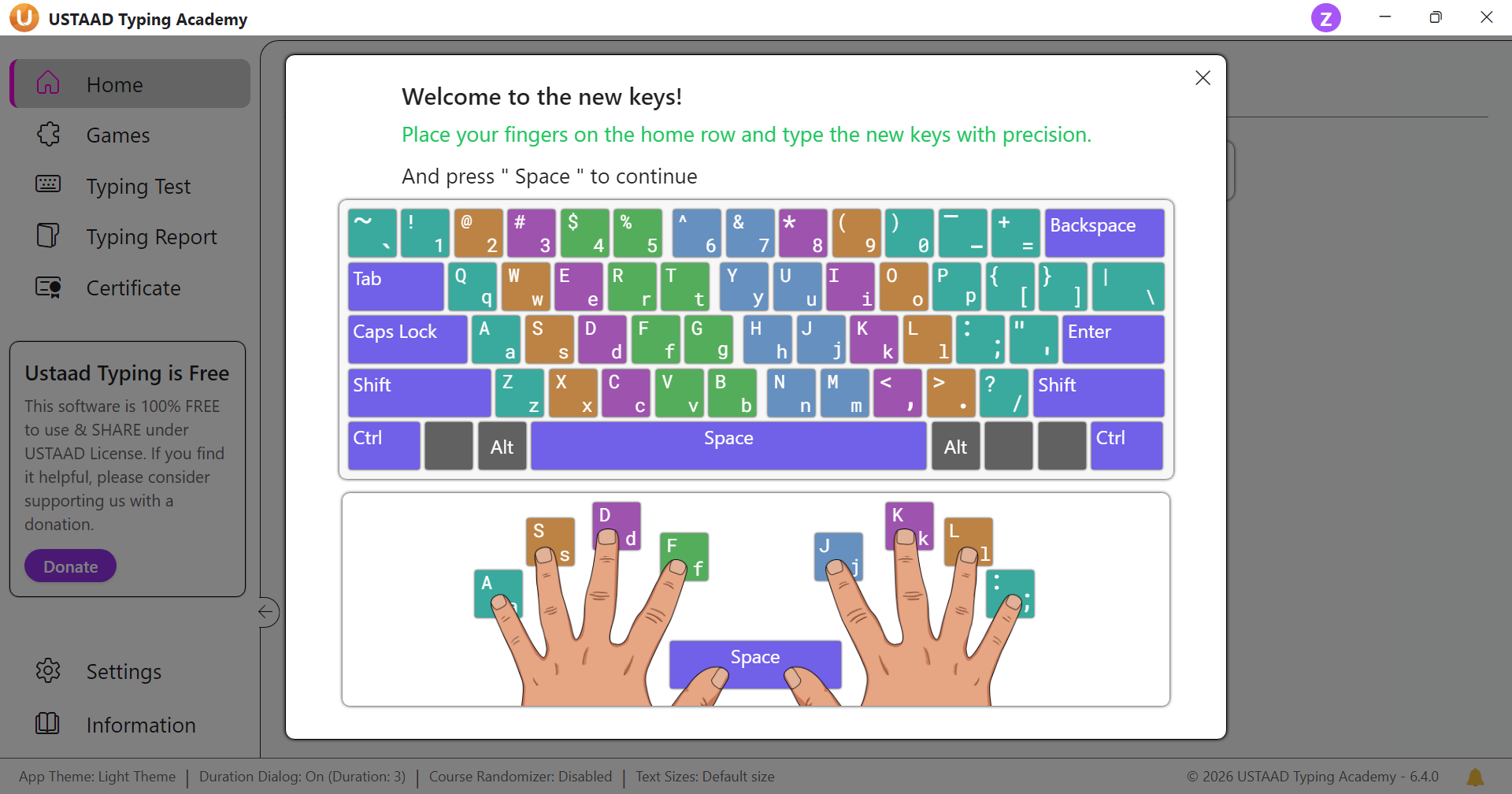
- Index fingers on F and J
- Middle fingers on D and K
- Ring fingers on S and L
- Pinky fingers on A, ;, Q, P, Z, /, [ , ] and ''
- Thumbs on the spacebar only
Use the home row as your anchor. Return your fingers to the home keys after every keystroke.
Beginner Mistakes to Avoid
- Looking at the keyboard instead of the screen
- Using the wrong finger for home row keys
- Moving your hands too much instead of keeping them steady
- Typing too fast too early before accuracy is established
- Skipping sentence practice and focusing only on letters
Progress Tracking and Speed Benchmarks
Track performance using USTAAD’s built-in progress tools.
Recommended targets for Chapter 1
- Accuracy: 90% or higher
- Speed: 15–20 WPM by the end of the chapter
- Daily practice: 20–30 minutes
- Review: Repeat exercises until accuracy is consistent
Why this matters
Chapter 1 is designed to create a solid typing foundation. Strong lowercase accuracy is the key to success in later chapters.
What Comes Next
After completing Chapter 1, you will be ready to move to Chapter 2: Shift Version, where USTAAD introduces uppercase letters, capitalization, and mixed-case typing.
This chapter-by-chapter learning path ensures you master lowercase typing before progressing to more advanced skills.